
Fuel prices constantly fluctuate, and drivers across the United States constantly look for ways to save money at the gas pump. Buying a car that gets excellent gas mileage remains one of the smartest financial decisions a driver can make. If you want to cut your commuting costs, you need to know about the most fuel efficient cars ever produced. Vehicle manufacturers have spent decades perfecting engine technology, aerodynamics, and hybrid systems to squeeze every possible mile out of a single drop of fuel.
In this comprehensive guide, we explore the cars with the best fuel economy in automotive history. We look at cutting-edge modern hybrids, engineering marvels of the past, and traditional gas-powered cars that punch above their weight. Whether you want to buy a brand-new commuter vehicle or just want to learn about the highest MPG cars ever built, this article gives you the exact data you need to make an informed choice.
What Makes a Car Fuel Efficient?
Automakers do not achieve incredible fuel economy by accident. Engineers spend thousands of hours designing, testing, and tweaking vehicles to reduce energy waste. Several crucial factors determine a vehicle’s overall fuel economy.
Vehicle Weight
Heavy cars require more energy to move. Every extra pound of weight forces the engine to burn more fuel. Manufacturers use lightweight materials like high-strength steel, aluminum, and carbon fiber to drop the overall weight of the vehicle. Lighter cars accelerate easier, brake faster, and use significantly less gas.
Aerodynamics
When you drive down the highway, your car pushes through a wall of air. Cars with boxy shapes fight wind resistance, which ruins gas mileage. Automakers design the cars with the best gas mileage using smooth, teardrop shapes. They add underbody panels, active grille shutters, and sleek rooflines to help the car slice through the wind effortlessly.
Engine Efficiency
Modern engines burn fuel much cleaner and smarter than older designs. Engineers use direct fuel injection, variable valve timing, and Atkinson-cycle engines to maximize power while minimizing fuel consumption. A smaller, highly efficient engine paired with a turbocharger often replaces larger, gas-guzzling V6 or V8 engines.
Hybrid Technology
Hybrid powertrains represent the biggest leap in fuel economy over the last twenty years. By pairing a traditional gasoline engine with an electric motor and a battery pack, hybrids recover wasted energy. The electric motor handles the heavy lifting during acceleration and low-speed driving, saving massive amounts of gasoline.
Driving Habits
Even the most efficient car will burn extra gas if the driver has a heavy foot. Smooth acceleration, coasting to red lights, and keeping your highway speed reasonable all contribute to better miles per gallon (MPG). A calm driver can easily beat the official EPA ratings of their vehicle.
Ranking the Top 10 Most Fuel Efficient Cars Ever
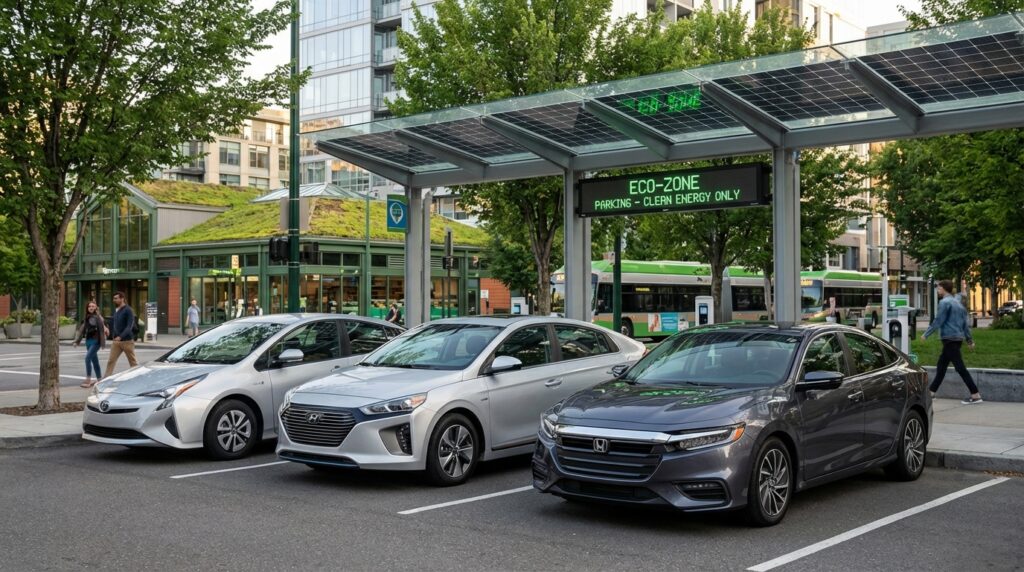
Let us dive into the ultimate list of the most fuel efficient cars ever made. We compiled this list by looking at combined MPG ratings from real-world testing and official agency data. Our list includes standard hybrids, ultra-efficient production cars, and plug-in hybrids that lead the automotive industry.
| Car Model | Engine Type | MPG (Combined) |
|---|---|---|
| Volkswagen XL1 | Diesel Plug-in Hybrid | 261 MPG (Est. Equivalent) |
| Hyundai Ioniq Hybrid (Blue) | Gas/Electric Hybrid | 58 MPG |
| Toyota Prius (Current Gen) | Gas/Electric Hybrid | 57 MPG |
| Hyundai Elantra Hybrid (Blue) | Gas/Electric Hybrid | 54 MPG |
| Toyota Prius Prime | Plug-in Hybrid | 54 MPG (133 MPGe) |
| Kia Niro Hybrid (FE) | Gas/Electric Hybrid | 53 MPG |
| Honda Insight (First Gen) | Gas/Electric Hybrid | 53 MPG (Modern EPA) |
| Toyota Camry Hybrid (LE) | Gas/Electric Hybrid | 52 MPG |
| Honda Civic Hybrid (Current) | Gas/Electric Hybrid | 50 MPG |
| Toyota Corolla Hybrid | Gas/Electric Hybrid | 50 MPG |
1. Volkswagen XL1
The Volkswagen XL1 takes the crown as an extreme engineering exercise. Volkswagen built a very limited number of these futuristic, two-seat vehicles for the European market. It features a tiny two-cylinder diesel engine paired with an electric motor. Because it weighs under 2,000 pounds and boasts a perfectly aerodynamic shape, it achieves an unbelievable 261 miles per gallon equivalent. While you cannot easily buy one today, it proves what automotive engineers can achieve.
2. Hyundai Ioniq Hybrid (Blue Trim)
Hyundai designed the Ioniq specifically to dethrone the Prius, and they succeeded. The Ioniq Blue trim delivers an outstanding 58 MPG combined, making it the highest-rated traditional hybrid car ever sold in the US market. Its dual-clutch transmission gives it a more natural driving feel compared to other hybrids, and its sleek hatchback design offers excellent cargo space. Though Hyundai recently discontinued the Ioniq to focus on full electric vehicles, it remains a legend for fuel savers.
3. Toyota Prius
You cannot talk about the highest MPG cars ever without mentioning the Toyota Prius. Toyota completely redesigned the Prius recently, giving it a stunning, sporty look without sacrificing its legendary fuel economy. The newest front-wheel-drive models achieve up to 57 MPG combined. Toyota perfected their hybrid synergy drive over twenty years, making the Prius the global gold standard for reliability and incredible gas mileage.
4. Hyundai Elantra Hybrid (Blue)
If you prefer a traditional sedan look over a hatchback, the Hyundai Elantra Hybrid delivers spectacular results. The “Blue” base trim strips away heavy luxury features to maximize efficiency, resulting in an impressive 54 MPG combined rating. It looks identical to the standard gas Elantra but packs a highly efficient electric motor inside. Drivers love the Elantra because it offers a spacious cabin and massive fuel savings without looking like a typical hybrid.
5. Toyota Prius Prime
The Prius Prime takes standard Prius efficiency and adds a larger battery that you can plug into a wall outlet. This allows the car to travel over 40 miles on pure electricity before the gas engine ever turns on. Because of this dual-nature system, the EPA rates it at 133 MPGe (Miles Per Gallon equivalent) when utilizing electric power, and it still achieves 54 MPG when running purely as a hybrid. It gives drivers the best of both worlds.
6. Kia Niro Hybrid (FE Trim)
Many American drivers prefer crossovers and SUVs over small sedans. The Kia Niro Hybrid perfectly bridges that gap. It sits higher off the ground and offers crossover styling, yet the base FE trim still manages an incredible 53 MPG combined. Kia shares much of the underlying hybrid technology with Hyundai, ensuring the Niro runs smoothly and sips fuel gently during daily city driving.
7. Honda Insight
Honda launched the original Insight in the year 1999, beating the Prius to the US market. The first-generation Insight featured a tiny three-cylinder engine, a manual transmission, and rear wheel skirts for maximum aerodynamics. Under modern EPA testing standards, the original Insight still rates at an amazing 53 MPG combined. Honda later revived the Insight as a larger sedan that achieved 52 MPG, proving their long-term dedication to building the cars with the best fuel economy.
8. Toyota Camry Hybrid (LE)
Building a tiny, lightweight car that gets good gas mileage is relatively easy. Building a spacious, midsize family sedan that achieves 52 MPG combined is an engineering miracle. The Toyota Camry Hybrid LE does exactly that. It comfortably seats five large adults, holds a massive amount of luggage, and rides incredibly smoothly on the highway. Toyota uses a highly refined 2.5-liter engine paired with powerful electric motors to achieve this feat.
9. Honda Civic Hybrid
Honda recently brought back the Civic Hybrid, and it immediately shot to the top of consumer wishlists. Delivering an estimated 50 MPG combined, the new Civic Hybrid offers a sporty, engaging driving experience that completely hides its eco-friendly nature. Honda uses a clever two-motor hybrid system that mostly uses the gas engine as a generator for the electric motors, resulting in instant torque and phenomenal efficiency.
10. Toyota Corolla Hybrid
The standard Toyota Corolla already enjoys a reputation for bulletproof reliability. When Toyota dropped their proven hybrid system into the Corolla, they created the ultimate budget-friendly commuter car. The Corolla Hybrid achieves 50 MPG combined and costs significantly less than many other hybrid options. It provides an affordable entry point for drivers who want to slash their monthly fuel budget.
Gas Cars with the Best Fuel Economy
While hybrid vehicles dominate the top of the MPG charts, not everyone wants to buy a hybrid. Some drivers prefer the simplicity and lower upfront cost of traditional gasoline-powered engines. Automakers still produce remarkably efficient non-hybrid cars.
Historically, lightweight cars from the 1980s and 1990s achieved incredible numbers. The famous Geo Metro XFi, for example, could hit over 45 MPG on the highway simply because it weighed barely more than a golf cart and had a tiny three-cylinder engine. The classic Honda CR-X HF achieved similar legendary status for high mileage without battery assistance.
In the modern era, the Mitsubishi Mirage stands out as the gas-powered champion. The Mirage uses a 1.2-liter three-cylinder engine and a continuously variable transmission (CVT) to achieve 39 MPG combined. Other excellent modern gas options include the standard Honda Civic (up to 36 MPG combined) and the Hyundai Elantra (up to 37 MPG combined). These cars use advanced aerodynamics and smart transmissions to rival the fuel economy of older hybrid models.
Hybrid vs Gas Mileage Comparison
To truly understand how much fuel you save by upgrading, you need to compare apples to apples. How much better is a hybrid compared to its exact gas-powered counterpart? The table below illustrates the massive efficiency advantage that hybrid systems provide.
| Vehicle Category | Average Gas MPG | Average Hybrid MPG | Efficiency Gain |
|---|---|---|---|
| Compact Sedan (e.g., Corolla) | 33 MPG | 50 MPG | +51% |
| Midsize Sedan (e.g., Camry) | 32 MPG | 52 MPG | +62% |
| Compact Crossover (e.g., RAV4) | 30 MPG | 40 MPG | +33% |
| Small Hatchback (e.g., Civic) | 35 MPG | 49 MPG | +40% |
As the data shows, choosing the most fuel efficient hybrid cars over their standard gas equivalents usually provides a 30 to 60 percent boost in total fuel economy. Over a typical five-year ownership period, this difference easily saves a driver thousands of dollars at the gas pump.
How Hybrid Cars Achieve High Fuel Economy
Many drivers know that hybrids save gas, but few understand exactly how the technology works. The secret lies in capturing energy that normal cars throw away.
First, hybrids utilize regenerative braking. When you step on the brake pedal in a normal car, the brake pads squeeze the rotors, creating friction and heat. That forward energy simply vanishes into the air. In a hybrid, pressing the brake pedal signals the electric motor to run in reverse. It acts as a generator, slowing the car down while simultaneously charging the battery pack. You recover energy every time you stop at a red light.
Second, hybrids excel in stop-and-go traffic. Traditional engines waste enormous amounts of fuel idling in traffic jams. A hybrid simply shuts its gas engine completely off when stopped or driving at very low speeds. The electric motor silently creeps the car forward in traffic using zero drops of gasoline.
Finally, electric motors provide instant torque. Because the electric motor handles the heavy strain of accelerating the car from a dead stop, engineers can use smaller, highly efficient Atkinson-cycle gas engines that focus entirely on smooth cruising power. For trusted, official data on how these systems work and to compare specific vehicle models, you can always visit the official U.S. Department of Energy Fuel Economy website.
Tips to Improve Your Car Fuel Efficiency
You do not need to buy a brand-new hybrid to save money on gas. You can drastically improve the fuel economy of the car you already drive by changing a few daily habits and keeping up with basic maintenance.
- Maintain Proper Tire Pressure: Under-inflated tires create rolling resistance. This forces your engine to work harder just to keep the car rolling. Check your tire pressure once a month and fill them to the manufacturer’s recommended level found inside the driver’s door jamb.
- Avoid Aggressive Acceleration: Jackrabbit starts from a red light burn massive amounts of extra fuel. Press the gas pedal smoothly and gently. Pretend you have a full cup of hot coffee sitting on your dashboard that you do not want to spill.
- Reduce Extra Weight: Do not use your car trunk as a storage unit. Remove heavy tools, sports equipment, and unnecessary items. Every 100 pounds of extra weight drops your fuel economy by about one percent.
- Keep Up with Regular Maintenance: A poorly maintained engine runs inefficiently. Replace dirty engine air filters, use the correct grade of motor oil, and change old spark plugs. A healthy engine simply burns less gas.
- Use Cruise Control on the Highway: Human drivers naturally speed up and slow down on the highway, which wastes gas. Engaging your cruise control keeps your speed perfectly steady, allowing the engine to settle into its most efficient rhythm.
- Limit Engine Idling: If you wait to pick someone up, turn your engine off. Idling gets exactly zero miles per gallon. Modern car starters handle frequent starts easily, so shutting the car off saves pure money.
Frequently Asked Questions
What is the most fuel efficient car ever made?
Technically, the limited-production Volkswagen XL1 holds the ultimate record, achieving an estimated 261 MPG equivalent. However, for mainstream, mass-produced vehicles available to the general public, the Hyundai Ioniq Hybrid Blue holds the record at 58 MPG combined, closely followed by the modern Toyota Prius at 57 MPG.
Which car has the highest MPG without being a plug-in?
The Hyundai Ioniq Hybrid Blue achieves the highest traditional gas mileage at 58 MPG. It does not require plugging into a wall. The car charges its own battery automatically using regenerative braking and power from the gasoline engine.
Are hybrid cars more fuel efficient than gas cars?
Yes, absolutely. Hybrid cars are significantly more fuel efficient than traditional gas-powered cars. By capturing braking energy and using an electric motor to assist the gas engine, hybrids usually get 30 to 60 percent better gas mileage than a comparable non-hybrid vehicle, especially in city driving conditions.
What car saves the most gas?
Plug-in hybrid electric vehicles (PHEVs) like the Toyota Prius Prime save the most gas for the average commuter. Because you can charge them at home and drive roughly 40 miles on pure electricity, many drivers complete their daily commute without using a single drop of gasoline for weeks at a time.
Conclusion
Finding the right vehicle requires balancing your budget, your lifestyle, and your driving habits. The most fuel efficient cars ever produced prove that we do not have to sacrifice comfort or reliability to achieve incredible gas mileage. Whether you choose the legendary Toyota Prius, the ultra-efficient Hyundai Elantra Hybrid, or a reliable gas-powered commuter, upgrading to a high-MPG vehicle offers outstanding long-term value.
Remember that excellent fuel economy goes beyond just the car you drive. By keeping your tires inflated, driving smoothly, and maintaining your engine, you can stretch your fuel budget even further. As automotive technology continues to advance, we look forward to even more brilliant engineering that will keep us moving forward while keeping our gas bills low.