


Buying a new vehicle stands out as an exciting life milestone. You spend hours researching models, taking test drives, and imagining yourself driving off the lot in a car that perfectly fits your lifestyle. However, before the dealer hands you the keys, you must pass the final financing test. When you sit down in the finance office, the first thing the lender checks is your financial history. This three-digit number acts as your permanent financial report card, and it dictates every borrowing option available to you. Therefore, figuring out what credit score is needed to buy a car becomes your most important task before you even set foot on a dealership lot.
If you plan to finance your next vehicle, your financial history plays a massive role in your overall success. Lenders use this specific number to predict how likely you are to repay the loan on time. A high score tells banks that you manage your money perfectly. A low score makes lenders nervous, which leads to higher costs, strict rules, and potential loan rejection.
This comprehensive guide will help you understand everything about the credit score to buy a car. We will explain exactly how banks view your financial background, what specific ranges guarantee the best deals, and how you can secure a reliable vehicle even if your financial past is less than perfect.
What Credit Score Do You Need to Buy a Car
Many eager shoppers want a simple, straightforward answer. They ask what credit score is needed to buy a car, expecting a single magic number that opens every door. In reality, the auto finance industry does not operate with one universal cutoff line. Technically, no official minimum credit score for car loan approval exists by law. Every bank, credit union, and auto finance company sets its own unique rules based on how much risk it wants to take.
However, just because you can get a loan with almost any score does not mean you will receive a good deal. Traditional banks and local credit unions typically prefer a score of 660 or higher. If your score falls below this mark, traditional lenders might reject your application quickly. When traditional banks say no, you must look for specialized subprime lenders who take on higher risks but charge much higher fees.
When you understand standard car loan credit score requirements, you realize that your score entirely determines your dealership experience. Let us look at a practical example. Imagine two different buyers walk into the exact same dealership on the same afternoon to buy the exact same vehicle.
- Buyer A has a score of 800. The dealer offers Buyer A a promotional zero-percent interest rate, asks for zero down payment, and treats them like a VIP. Buyer A signs the paperwork in ten minutes and drives away.
- Buyer B has a score of 550. The dealer tells Buyer B they need a massive cash down payment, requires three months of pay stubs, and offers a loan with a staggering 18 percent interest rate.
Both buyers leave the lot with a car, but Buyer B pays thousands of dollars more over the life of the loan. Therefore, the real question involves more than just getting an approval. You must ask yourself what score you need to get a comfortable, affordable monthly payment.
Average Credit Score Needed for a Car Loan
Because every bank offers different lending programs, looking at national industry averages gives you a clearer picture of the current market. The average credit score for car financing changes slightly depending on whether you want to buy a brand-new vehicle or a pre-owned model.
If you want to buy a brand-new car straight from the factory, you generally need a stronger financial profile. Recent market data shows that the average score for a new car loan hovers around 730. New cars cost significantly more money, meaning banks take on a much larger financial risk. To offset this massive risk, financial institutions prefer buyers who have a proven track record of paying all their bills on time.
On the other hand, used car loans typically feature lower entry barriers. The average score for a used car loan usually sits around 670. Used cars have already experienced their steepest depreciation drop. Because the total loan amounts remain smaller, lenders feel much more comfortable approving buyers with average or slightly below-average credit profiles.
You should always aim to build your score as close to these averages as possible before you shop. Hitting the average credit score for car financing puts you in a strong negotiating position. You can shop around at different local banks, compare multiple offers, and force lenders to compete for your business. Conversely, when your score falls far below the average, you lose your negotiating power and must accept whatever harsh terms the lender decides to offer.

Car Loan Credit Score Ranges Explained
Lenders group buyers into specific tiers based on their credit scores. These tiers help banks quickly determine your risk level and assign an interest rate to your application. While different bureaus might use slightly different names for these groups, the auto industry generally follows four main categories.
Excellent credit score (781 to 850)
If your score sits in this top tier, lenders consider you a “super prime” borrower. You have a long history of making on-time payments, you keep your credit card balances incredibly low, and you manage your debts responsibly over many years.
When you have an excellent score, you hold all the power. Dealerships and banks will actively fight for your business. You easily qualify for the absolute lowest promotional interest rates advertised on television. Furthermore, lenders rarely ask you for a down payment or proof of income. You can negotiate the best terms, choose any loan length you desire, and enjoy a completely stress-free buying experience.
Good credit score (661 to 780)
Lenders classify buyers in this healthy range as “prime” borrowers. You might have a few minor blemishes on your credit report from years ago, or perhaps your credit history remains just a bit young.
Having a good score means you easily meet standard auto finance requirements. You will rarely face a loan rejection. While you might not qualify for the absolute lowest promotional rates reserved for the top tier, you will still receive highly competitive offers. Most traditional banks and credit unions will happily finance your vehicle. You can still buy almost any car you can afford without jumping through frustrating administrative hoops.
Fair credit score (601 to 660)
The auto finance industry calls this the “non-prime” tier. Buyers in this middle-ground category often have several missed payments, high credit card utilization, or a very short credit history.
If you have a fair score, you face a major turning point. You will likely find a lender willing to finance your purchase, but your choices shrink quickly. Traditional banks might approve you, but they will charge a noticeably higher interest rate to cover their perceived risk. The dealership might require a modest down payment to secure the loan. You must read your loan documents carefully, as your monthly payment will directly reflect the higher interest charges.
Poor credit score (300 to 600)
Lenders refer to buyers in this bottom zone as “subprime” or “deep subprime” borrowers. This low score usually indicates serious financial missteps, such as recent bankruptcies, account charge-offs, auto repossessions, or frequent late payments.
When your score falls into the poor category, buying a car becomes a challenging task. Most major banks will automatically deny your application. You must rely entirely on specialized subprime lenders. These specific lenders charge incredibly high interest rates, demand large cash down payments, and restrict the types of cars you can buy. They often refuse to finance older cars or vehicles with high mileage because the risk of mechanical failure remains too high.
To help you visualize your chances, review this simple breakdown of loan approval odds based on your specific tier:
| Credit Tier | Score Range | Loan Approval Chances | Expected Loan Terms |
|---|---|---|---|
| Excellent | 781 – 850 | Almost Guaranteed | Lowest interest rates, zero down payment options |
| Good | 661 – 780 | Very High | Competitive rates, easy approval process |
| Fair | 601 – 660 | Moderate | Higher rates, modest down payment required |
| Poor | 300 – 600 | Low to Challenging | Maximum interest rates, large down payment required, limited car choices |
Can You Buy a Car With Bad Credit

Many buyers facing tough financial struggles frequently wonder, “can you buy a car with bad credit?” The short answer remains yes. You absolutely can buy a car with bad credit. However, the process requires patience, deep research, and a clear understanding of the extra costs involved.
When you have bad credit, you cannot simply walk into any random dealership and expect a smooth, fast transaction. You must seek out specific dealerships that operate specialized finance departments. These finance managers work directly with subprime auto lenders who specialize in helping high-risk buyers. Subprime lenders look past your credit score. Instead, they focus heavily on your current gross income, your employment stability, and your current housing situation.
Some buyers with extremely poor credit turn to “Buy Here, Pay Here” (BHPH) dealerships. These specific car lots act as both the vehicle seller and the bank. They do not use outside lending networks. Because they finance the car in-house, they rarely check your credit score. If you bring a steady paycheck and a solid cash down payment, a BHPH dealer will hand you the keys.
Important Warning: While Buy Here Pay Here dealerships offer an incredibly easy approval process, they come with severe drawbacks. They usually charge the maximum legal interest rate allowed in your state. They install GPS tracking devices on your car to repossess it instantly if you miss a payment by even one day. Furthermore, many of these dealers never report your on-time payments to the major credit bureaus. This means you could make perfect payments for three years and your financial profile will not improve at all. Always ask the dealer if they report to Equifax, Experian, and TransUnion before you sign a contract.
How Credit Score Affects Your Car Loan Interest Rate
Your credit score directly controls your Annual Percentage Rate (APR). The APR represents the total yearly cost of borrowing money, including the base interest and any extra lender fees. A lower score automatically triggers a higher APR, which drastically increases the total amount of money you pay for the exact same vehicle.
Understanding this math helps you see exactly why improving your financial profile matters so much. Lenders use a banking technique called “risk-based pricing.” They charge high-risk borrowers extra money every single month to build a safety net. If a high-risk borrower suddenly stops making payments, the lender has already collected enough extra interest upfront to reduce their overall financial loss.
Let us look at a realistic financial example to demonstrate this impact. Suppose you want to buy a reliable used SUV. You plan to finance $25,000 over 60 months (five years). Here is how your credit tier completely changes the overall cost of that vehicle:
| Credit Tier | Estimated APR | Estimated Monthly Payment | Total Interest Paid Over 60 Months |
|---|---|---|---|
| Excellent | 5.0% | $472 | $3,320 |
| Good | 8.0% | $507 | $5,415 |
| Fair | 14.0% | $582 | $9,905 |
| Poor | 20.0% | $662 | $14,740 |
When you review the numbers above, the financial reality becomes shocking. The buyer with poor credit pays over $11,000 more in pure interest compared to the buyer with excellent credit, even though they purchased the exact same $25,000 vehicle. This stark reality highlights exactly why you should never ignore your financial health before visiting a dealership.
Tips to Improve Your Credit Score Before Buying a Car
If you have some time before you absolutely need to purchase a vehicle, you should take proactive steps to improve your credit profile. Even a small increase of 20 or 30 points can push you into a better lending tier and save you thousands of dollars in interest. Follow these highly practical tips to boost your score safely.
- Check your credit reports for errors: You have the legal right to claim a free copy of your credit report from all three major bureaus every year. Review these reports closely. Look for accounts that do not belong to you, incorrect late payment marks, or outdated collection accounts. Dispute any errors you find immediately. The bureaus must remove unverified negative marks, which gives your score an instant lift.
- Lower your credit card balances: Your credit utilization ratio compares the amount of revolving debt you owe against your total available credit limits. Lenders strongly prefer a ratio below 30 percent. Pay down your credit card balances as much as possible before you apply for an auto loan.
- Always pay your bills on time: Payment history makes up the largest chunk of your total score calculation. Set up automatic payments on your smartphone or computer. Never miss a due date. Even one single 30-day late payment can cause your score to plummet drastically.
- Do not open new credit accounts: Every time you apply for a new credit card or personal loan, the lender performs a “hard inquiry” on your report. Hard inquiries cause a temporary dip in your score. Avoid applying for any new credit for at least six months before you visit a car dealership.
- Keep old accounts open: The length of your credit history matters deeply. Do not close your oldest credit card, even if you rarely use it anymore. Closing an old account shrinks your available credit and shortens your financial history, which hurts your score.
- Become an authorized user: Ask a trusted parent or spouse to add you as an authorized user on their oldest credit card. Assuming they have a perfect payment history and a low balance, their excellent account history will import onto your report and boost your numbers quickly.
How to Get Approved for a Car Loan With Low Credit
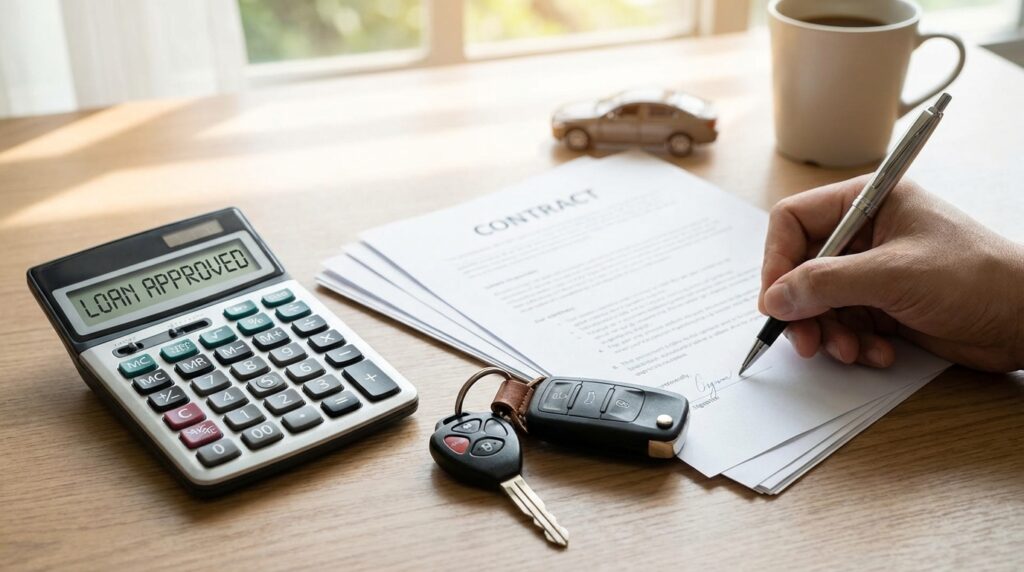
Sometimes, life happens unexpectedly. Your old car breaks down permanently, and you need a reliable replacement immediately so you can get to work. You do not have six months to sit around and fix your credit. If you must secure financing right now despite having a low score, you can use several proven strategies to force an approval.
Save up a larger down payment. Cash remains king when you have a poor financial history. Lenders look closely at the Loan-to-Value (LTV) ratio. If you want to buy a $15,000 car and you put down $3,000 in cash, you only need to borrow $12,000. This smaller loan amount reduces the bank’s risk significantly. A large down payment proves your financial commitment and instantly increases your approval odds.
Find a reliable co-signer. A co-signer acts as your safety net. This trusted friend or family member must have excellent credit and a strong, verifiable income. By signing the official loan documents with you, the co-signer legally promises to make the monthly payments if you fail to do so. The bank uses the co-signer’s strong financial profile to approve the loan. Just remember, if you miss a payment, you ruin your co-signer’s credit score too.
Provide solid proof of stability. Subprime lenders desperately want to see that your chaotic financial days belong firmly in the past. Bring your most recent pay stubs, W-2 forms, and bank statements to the dealership to prove you earn a steady income. Bring a recent utility bill to prove you have lived at the same permanent address for a while. Job stability and housing stability make lenders feel much safer about lending you money.
Shop at local credit unions. Big national banks rely on strict computer algorithms to approve or deny loans. Local credit unions operate quite differently. They value deep community relationships. If you sit down face-to-face with a loan officer at a local credit union and honestly explain the reasons behind your past financial troubles (such as a medical emergency), they might approve your loan manually.
Choose an affordable vehicle. When you have bad credit, you must leave your luxury dream car at the dealership. Pick a modest, highly reliable, and inexpensive used car. A cheaper car means a much smaller loan request. Lenders approve small loans much faster than large ones.
Frequently Asked Questions
What is the lowest credit score a car dealer will accept?
The auto industry has no absolute lowest limit. Dealerships that offer in-house financing (Buy Here, Pay Here) will often accept scores deep into the 400s or even approve buyers who have zero credit history at all. However, traditional banks and standard dealerships usually draw the line around 550 to 600. If your score falls below 550, you almost certainly need a subprime lending specialist, a massive cash down payment, or a highly qualified co-signer.
Does a car loan build my credit score?
Yes, an auto loan provides an incredibly excellent way to build your credit. An auto loan adds an installment account to your overall credit mix, which the reporting bureaus love to see. As long as you make your full payment on time every single month, your score will steadily rise over the life of the loan. Just make sure you verify that your specific lender reports your payment activity to the major bureaus.
Is it better to get a car loan from a bank or a dealership?
You should always get pre-approved by a traditional bank or local credit union before you ever visit the dealership. Getting a pre-approval tells you exactly how much money you can borrow and what specific interest rate you qualify for. You can then take this solid offer to the dealership and ask their finance manager to beat it. Dealerships have direct access to massive lending networks, and they can sometimes find you a lower promotional rate to win your business.
How much of a down payment do I need with bad credit?
While specific rules vary by lender, most subprime banks require a down payment of at least 10 percent of the car’s total purchase price, or $1,000 in cash, whichever number is higher. Providing a 20 percent down payment works even better. The more cash you put down upfront, the easier you make the approval process and the less interest you pay over the life of the loan.
Will checking my credit score before buying a car lower it?
No. When you check your own credit report through a free monitoring service or directly through a major bureau, the system logs it as a “soft inquiry.” Soft inquiries never impact your score. However, when a dealership submits your official application to banks, the banks perform “hard inquiries.” To protect car shoppers, credit bureaus usually group all auto loan hard inquiries made within a 14-day window into one single event. Therefore, your score only takes a minor, temporary hit while you shop around for the best rate.
Conclusion
Your credit score holds the ultimate key to your automotive freedom. Understanding exactly what credit score is needed to buy a car empowers you to make much smarter financial decisions before you ever step onto a dealership lot. You certainly do not need a perfect 850 to drive a safe, reliable vehicle, but aiming for a score above 660 makes the entire financing process smoother, faster, and significantly cheaper.
If your score currently sits in the lower, subprime tiers, do not panic. Use the practical strategies outlined in this guide to secure affordable financing today, or take a few dedicated months to rebuild your financial profile. Treat your credit history like a highly valuable asset, protect it fiercely, and you will always drive away with the best possible deal.
According to financial experts at Experian, lenders use your credit score to determine your loan approval chances and interest rate.
Learn more about car loan credit requirements