
Toyota Camry vs Honda Accord is the most legendary rivalry in the midsize sedan world, shaping decades of family road trips and daily commuting decisions.
However, the gap between them has widened in recent years. Toyota has made a bold move by making the new Camry exclusively a hybrid with available All-Wheel Drive (AWD). Honda, meanwhile, keeps a gas-only option for budget buyers but saves its best features for the hybrid trims. One prioritizes soft, efficient comfort, while the other leans into sharp design and driving dynamics.
This guide cuts through the marketing noise. We will analyze real-world ownership costs, driving feel, and long-term reliability to help you decide which sedan actually belongs in your driveway.
Quick Comparison Table (At-A-Glance)
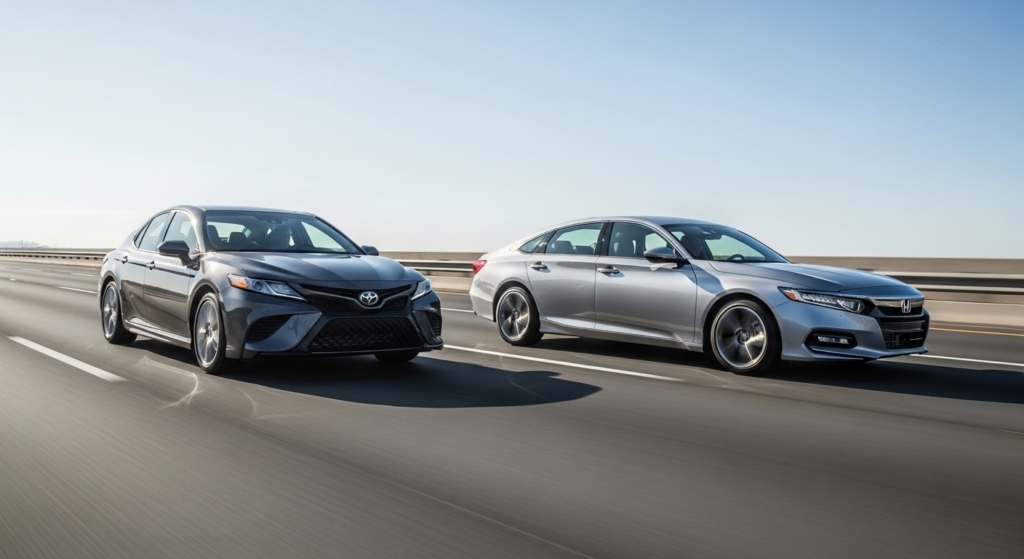
Before we dive deep, here is how the current models stack up on paper. This comparison focuses on the latest generation models (2025 Camry vs. 11th Gen Accord).
| Feature | Toyota Camry (2025) | Honda Accord (11th Gen) |
|---|---|---|
| Base Engine | 2.5L 4-Cylinder Hybrid (Standard) | 1.5L Turbo 4-Cylinder (Gas) |
| Horsepower | 225 hp (FWD) / 232 hp (AWD) | 192 hp (Gas) / 204 hp (Hybrid) |
| Drivetrain | FWD or AWD Available on all trims | FWD Only (No AWD option) |
| Combined MPG | 51 MPG (LE FWD) | 32 MPG (Gas) / 48 MPG (Hybrid) |
| Rear Legroom | 38.0 inches | 40.8 inches |
| Trunk Space | 15.1 cu. ft. | 16.7 cu. ft. |
| Warranty | 3yr/36k Basic + 2yr Free Maintenance | 3yr/36k Basic + 2yr Free Maintenance |
Reliability Comparison
When you buy a Camry or an Accord, you are essentially buying peace of mind. Both brands have built their empires on cars that start every morning for 15 years straight. However, there are nuances for the long-term owner.
Toyota Camry Reliability
The Camry is widely considered the king of durability. The new generation utilizes Toyota’s 5th-generation Hybrid System. This technology is not new; it has been refined over two decades in the Prius and RAV4. The 2.5L naturally aspirated engine paired with electric motors is a low-stress setup. There are no turbochargers to fail, and the e-CVT transmission is mechanically simple and incredibly robust.
Toyota Camry reliability after 100k miles
Honda Accord Reliability
The Accord is also excellent, but it uses a different approach. The lower trims use a 1.5L Turbocharged engine with a CVT (Continuously Variable Transmission). While Honda has addressed previous issues, turbo engines generally operate under higher pressure and stress than naturally aspirated hybrids. The Accord Hybrid trims utilize a 2.0L Atkinson cycle engine which is historically very reliable, rivaling the Camry for longevity.
“Expert Insight: If you plan to keep the car for 200,000 miles or more, the non-turbo hybrid setup in the Camry is statistically the safer bet. However, the Accord Hybrid is a very close second.”
Engine & Performance
Gone are the days when these were just “slow family cars.” Both vehicles offer adequate power, but they deliver it very differently.
Driving the Toyota Camry
The Camry has ditched the V6 engine. Now, you get a hybrid system across the board. The result is smooth, instant torque from the electric motors when you step on the gas. It is not a sports car, but with 225 horsepower (or 232 hp with AWD), it merges onto highways with confidence.
The suspension is tuned for comfort. It soaks up potholes and bumps effortlessly. The steering is light, making parking lots easy, but it doesn’t offer much feedback on twisting roads.
Driving the Honda Accord
The Honda Accord retains its title as the “driver’s car” in this segment. The steering feels more connected to the road, and the chassis is stiffer, allowing for flatter cornering. The base 1.5T engine (192 hp) feels peppy around town but can sound a bit strained at high speeds.
The Accord Hybrid (204 hp) is the sweet spot. It feels more electric-dominant than previous versions, offering a linear and quiet acceleration that feels more premium than the Camry.
Key Difference: If you live in a snowy climate, the Toyota Camry is the winner because it offers All-Wheel Drive (AWD). The Honda Accord is strictly Front-Wheel Drive (FWD).
Fuel Economy Comparison
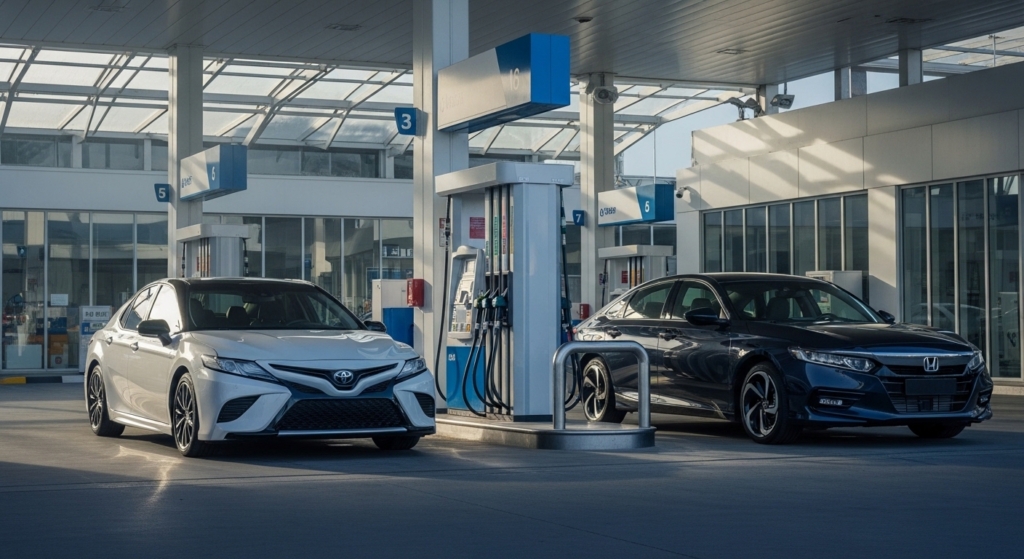
This is where the battle heats up. Since the Camry is now all-hybrid, its baseline efficiency is incredibly high. Honda splits the difference between gas and hybrid models.
| Model & Trim | City MPG | Highway MPG | Combined MPG |
|---|---|---|---|
| Toyota Camry LE (FWD) | 53 | 50 | 51 |
| Toyota Camry XSE (AWD) | 44 | 43 | 44 |
| Honda Accord LX/EX (Gas) | 29 | 37 | 32 |
| Honda Accord Sport/Touring (Hybrid) | 46 | 41 | 44 |
The Reality: In real-world driving, the Camry LE is the undisputed efficiency champion, easily hitting 50 MPG. The Accord Hybrid is excellent, but its larger wheels on top trims (Sport/Touring) drag the efficiency down slightly compared to the base Camry.
Interior Comfort & Technology
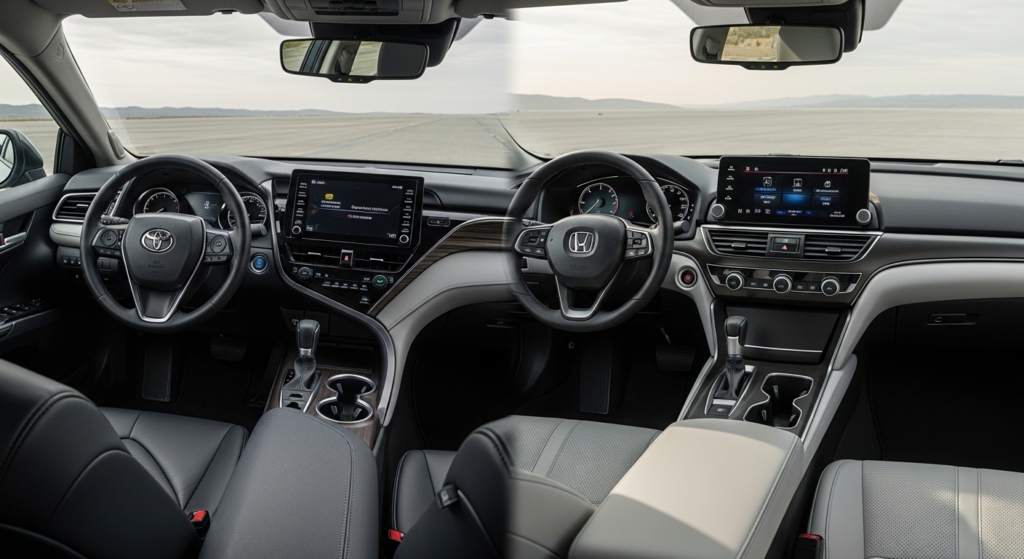
You spend your time inside the car, so this section is critical. Both manufacturers have taken drastically different design philosophies.
Honda Accord Interior
Honda went for a minimalist, modern, and airy feel. A metal honeycomb mesh spans the dashboard, hiding the air vents. The materials feel premium, and the knobs click with a satisfying tactile feel.
- Space: The Accord has massive rear legroom (40.8 inches). It feels like a full-size luxury sedan in the back.
- Tech: The top-trim Touring features “Google Built-in,” meaning Google Maps and Assistant are native to the car. The 12.3-inch screen is crisp and responsive.
Toyota Camry Interior
The Camry feels more traditional but very functional. It uses a layered dashboard design with soft-touch materials in key areas. The seats are widely regarded as slightly softer and more cushiony than the firmer Honda seats.
- Space: The rear seat is spacious enough for adults but feels tighter than the Accord. The AWD hardware also eats up a tiny bit of space underneath.
- Tech: The new Toyota Audio Multimedia system is five times faster than the old one. Wireless Apple CarPlay and Android Auto are standard on all trims.
Safety Features Comparison
Both cars are safety fortresses. You cannot make a bad choice here, as both typically earn top marks from the IIHS (Insurance Institute for Highway Safety).
Toyota Safety Sense 3.0 (TSS 3.0)
Standard on every single Camry, regardless of price. It includes:
- Pre-Collision System with Pedestrian Detection
- Lane Departure Alert with Steering Assist
- Full-Speed Range Dynamic Radar Cruise Control
- Proactive Driving Assist (subtly brakes for curves)
Honda Sensing
Standard on all Accords. It includes similar features:
- Collision Mitigation Braking System
- Road Departure Mitigation
- Adaptive Cruise Control with Low-Speed Follow
- Traffic Jam Assist
The Verdict: Toyota’s system feels slightly less intrusive. The Lane Tracing Assist in the Camry centers the car more naturally on the highway, whereas the Accord can sometimes “ping-pong” slightly between lane lines.
Maintenance & Repair Costs
Ownership costs are where these cars shine compared to European rivals. Both are incredibly cheap to keep on the road.
Scheduled Maintenance Programs
Both Toyota and Honda now offer complimentary scheduled maintenance for the first 2 years or 25,000 miles (whichever comes first). This covers your oil changes and tire rotations.
Long-Term Repairs
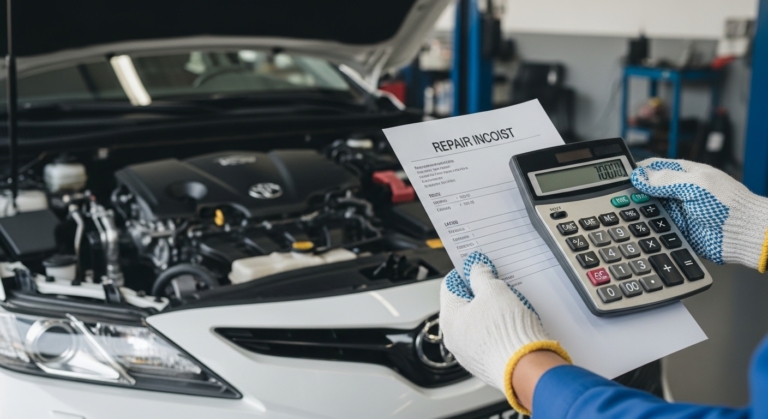
According to data from RepairPal and other consumer advocacy groups, the annual repair cost for midsize sedans averages around $500-$600. The Camry and Accord consistently come in below this average.
- Toyota: Parts are globally available and cheap. The hybrid battery warranty is excellent (10 years/150,000 miles).
- Honda: Slightly more expensive for certain complex repairs (like the Turbo on the 1.5L engine), but generally very affordable.
Resale Value & Depreciation
If you plan to sell your car in 5 years, you want the one that retains value. Historically, the Toyota Camry holds its value slightly better, primarily because of its fleet reputation and the high demand for used Toyotas.
However, the gap is narrow. A well-maintained Honda Accord will still command a premium price on the used market. You will likely lose about 35-40% of the car’s value over 5 years, which is much better than the industry average of 50%.
Used Toyota Camry vs Used Honda Accord
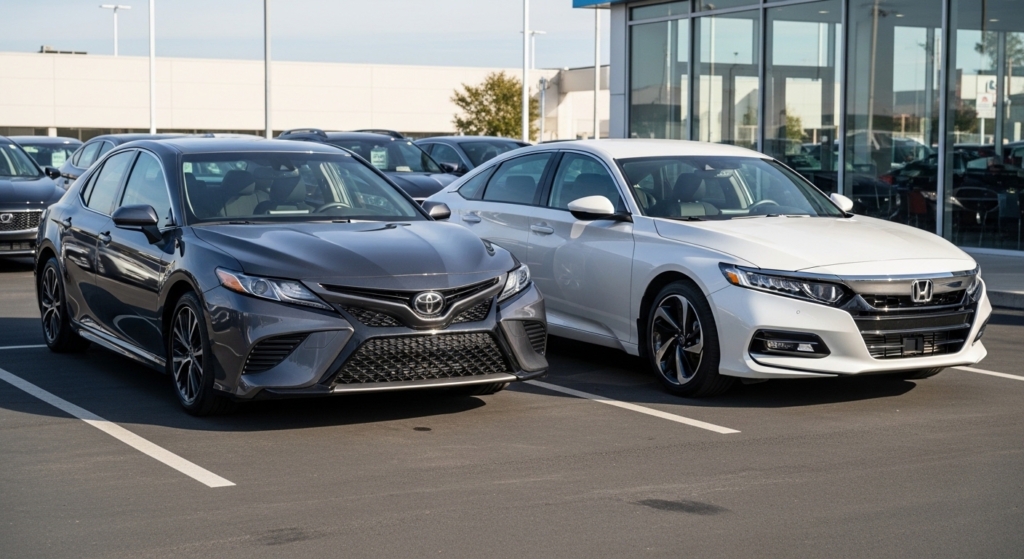
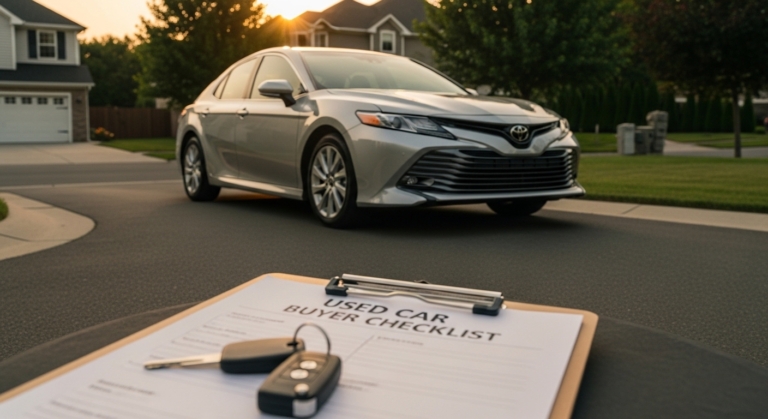
If you are buying used (2018-2023 models), the comparison changes slightly.
Used Toyota Camry (8th Gen)
Look for the 2018-2024 models. You can find the 3.5L V6 engine in these years. This engine is a gem—301 horsepower, bulletproof reliability, and very fast. If you dislike hybrids and want raw power, a used V6 Camry XSE or TRD is a fantastic buy.
Is a used Toyota Camry worth buying?
Used Honda Accord (10th Gen)
Look for the 2018-2022 models with the 2.0L Turbo engine. This engine was a detuned version of the Civic Type R motor. It was paired with a 10-speed automatic (no CVT). Enthusiasts love this car because it is genuinely fast and fun. However, avoid early 2018 models with the 1.5L engine due to potential A/C condenser and oil dilution issues.
Pros and Cons Summary
Toyota Camry Pros
- Standard Hybrid powertrain delivers amazing MPG
- Available All-Wheel Drive (AWD)
- Softer, more comfortable ride quality
- Slightly better historical reliability ratings
- Quieter cabin at highway speeds
Honda Accord Pros
- Best-in-class rear legroom
- Sportier handling and steering feel
- More modern, upscale interior design
- Larger trunk space
- Better infotainment interface (Google Built-in)
Toyota Camry Cons
- Rear seat is tighter than the Accord
- Interior design feels a bit older/busier
- No high-performance engine option anymore
- AWD not available on every single package configuration
Honda Accord Cons
- No All-Wheel Drive option (Dealbreaker for some)
- Base engine is gas-only (lower MPG)
- CVT transmission can drone under hard acceleration
- Hybrid trims are more expensive to start
Who Should Buy Each Car?
Still on the fence? Here is the final breakdown based on buyer types.
Buy the Toyota Camry if:
- You prioritize MPG: You want 50+ MPG without thinking about it.
- You live in the snow: You need AWD for winter traction.
- You want comfort: You prefer a suspension that floats over bumps rather than feeling the road.
- You are a long-term keeper: You plan to drive this car for 15 years and want the lowest risk of mechanical issues.
Buy the Honda Accord if:
- You have tall passengers: You need that massive rear legroom for teenagers or clients.
- You enjoy driving: You appreciate sharp steering and a car that handles curves well.
- You want tech: You want the Google integration and a cleaner, more modern dashboard.
- You need trunk space: The Accord’s trunk is larger and easier to load.
Frequently Asked Questions (FAQ)
Is the Toyota Camry faster than the Honda Accord?
The new Camry Hybrid (225-232 hp) is faster than the base Honda Accord 1.5T (192 hp). However, the Honda Accord Hybrid (204 hp) feels very responsive due to its electric motor torque, even if the Camry has a slight horsepower advantage on paper.
Which car lasts longer, Camry or Accord?
Both are capable of reaching 200,000 miles with ease. However, statistical data often puts the Toyota Camry slightly ahead in extreme high-mileage scenarios, largely due to its non-turbocharged engine lineup.
Does the Honda Accord have AWD?
No. As of the current generation, the Honda Accord is Front-Wheel Drive (FWD) only. If you need AWD in a Honda sedan, you have to look at the Acura TLX or switch to a CR-V.
Is the maintenance cheaper on a Camry or Accord?
They are virtually tied. Parts for both are cheap and widely available. Toyota’s hybrid battery warranty is slightly more reassuring for high-mileage drivers.
Toyota Camry vs Honda Accord: Quick Answer
If you want maximum fuel efficiency, long-term reliability, and available AWD, the Toyota Camry is the better choice. If you value driving feel, interior space, and a more premium cabin, the Honda Accord is the better option.
Final Verdict
The battle of Toyota Camry vs Honda Accord results in a very close finish, but the winner depends entirely on your specific needs.
The Toyota Camry is the better appliance. It is the logical choice for the majority of buyers because it offers standard hybrid efficiency and optional AWD—two features that matter most to daily commuters. It is a car you buy with your head, knowing it will save you money on gas and repairs for a decade.
The Honda Accord is the better experience. It looks better inside, drives better, and offers significantly more space for passengers. It feels like a class above the Camry in terms of refinement and style. If you can live without AWD and don’t mind slightly lower MPG on the base trims, it is the more enjoyable car to live with every day.
Our Recommendation: Test drive the Camry LE first. If the drive feels too boring or the back seat is too small, go buy the Accord Hybrid. You cannot lose with either.