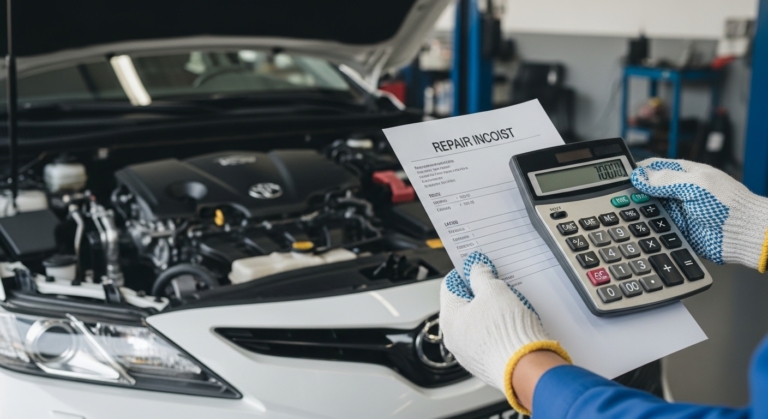

The Toyota Camry is the gold standard for mid-size sedans. It is famous for its reliability, resale value, and comfortable highway cruising. However, even the most durable machines eventually face wear and tear. If your smooth ride has turned bouncy, or you hear strange clunks when pulling into your driveway, you are likely dealing with Toyota Camry suspension problems.
The suspension system is the unsung hero of your vehicle. It bears the weight of the car, absorbs shocks from potholes, and ensures your tires stay planted on the road for safe braking and cornering. When components fail, it isn’t just an annoyance; it becomes a safety hazard.
In this guide, we will break down the most common suspension issues found in various Camry generations. You will learn how to identify warning signs, understand the causes of a Toyota Camry rough ride, and get a realistic look at Toyota Camry suspension repair cost so you aren’t blindsided at the mechanic’s shop.
How Reliable Is the Toyota Camry Suspension System?
Generally, the Toyota Camry suspension system is incredibly robust. Toyota engineers design these cars for longevity, knowing they will be used as daily commuters, family haulers, and rideshare vehicles. Unlike some European sedans that use complex air suspension or over-engineered multi-link setups that fail early, the Camry typically uses a straightforward MacPherson strut front suspension and a multi-link rear setup (in newer models).
However, reliability does not mean invincibility. Suspension parts are “wear items.” Just like brake pads or tires, shocks and bushings have a finite lifespan. Most Toyota Camry suspension issues arise simply due to mileage and age rather than manufacturing defects. That said, certain model years—specifically the 2007–2011 generation—have seen higher rates of premature strut failure compared to others.
Important Note: While the Camry engine might run forever, suspension components usually degrade significantly between 80,000 and 120,000 miles. If you have passed this milestone, your suspension is likely living on borrowed time.
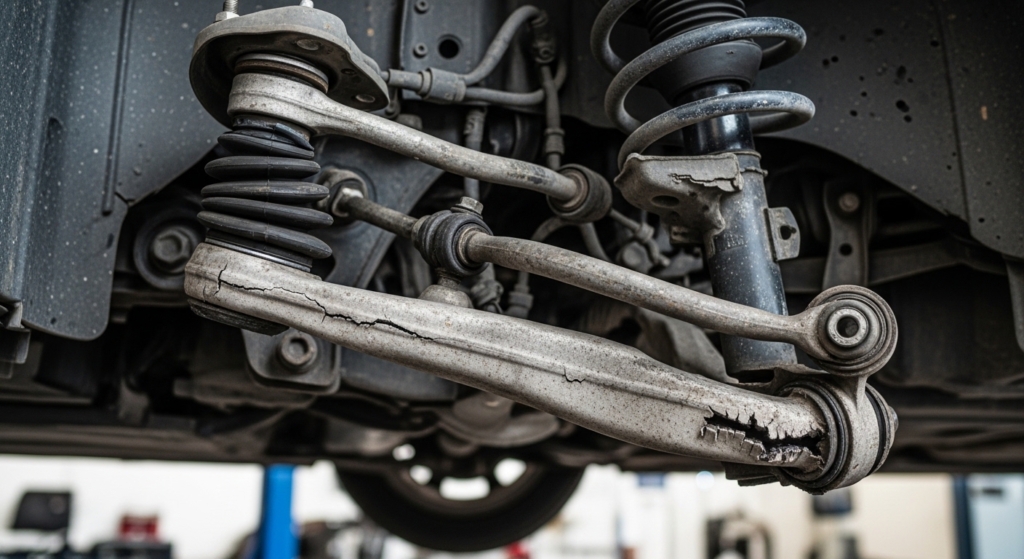
Most Common Toyota Camry Suspension Problems
When diagnosing a suspension issue, specific symptoms usually point to specific parts. Below are the most frequent problems Camry owners encounter.
Worn Struts and Shocks
This is the number one cause of a Toyota Camry rough ride. The struts and shocks dampen the energy from the springs. When they wear out, the car relies solely on the springs, leading to excessive bouncing.
- Symptoms: The car continues to bounce after hitting a bump (the “porpoising” effect), nose-diving when braking, rear squatting when accelerating, and visible oil leaking from the strut housing.
- Main Causes: Internal seals wear out over time, causing hydraulic fluid to leak. Continual driving on rough roads accelerates this process.
- Severity Level: Medium to High. Worn struts increase stopping distance significantly.
Clunking or Knocking Noise Over Bumps
One of the most annoying Toyota Camry suspension issues is a distinct clunk, rattle, or knock when driving over speed bumps or uneven pavement. This noise is often misdiagnosed as a loose trunk item, but it is usually mechanical.
- Symptoms: A metallic clunk or hollow knocking sound coming from the front or rear wheel wells when the suspension compresses.
- Main Causes: Worn strut mounts or failed sway bar links. The strut mount bearing can seize, or the rubber isolator can crack, causing metal-on-metal contact.
- Severity Level: Low to Medium. It typically starts as a noise nuisance but can lead to handling issues if the part separates.
Uneven Tire Wear
Your tires tell the story of your suspension’s health. If you notice Camry uneven tire wear, it is a clear sign that the suspension geometry is off.
- Symptoms: The inside or outside edge of the tire tread is worn smooth while the rest looks new (camber wear), or the tread feels sharp or “feathered” when you run your hand across it.
- Main Causes: Misalignment caused by worn control arm bushings, bent tie rods, or sagging springs.
- Severity Level: Medium. It wastes money on tires and reduces traction in wet conditions.
Broken Control Arm Bushings
The control arms connect the wheel hub to the vehicle’s frame. They pivot on rubber bushings that eventually dry rot and crack.
- Symptoms: A clunking noise when shifting from drive to reverse, steering wandering (the car won’t drive straight), or a loose feeling in the steering wheel.
- Main Causes: Age and heat cause the rubber to become brittle and crack. Road salt can also corrode the metal sleeve inside the bushing.
- Severity Level: Medium. Failed bushings make the car difficult to align and control.
Sway Bar Link Failure
Sway bar links (or stabilizer links) connect the sway bar to the suspension components to keep the car level during turns. These are common failure points on the Camry.
- Symptoms: A rapid rattling or clattering noise when driving over small road imperfections. The noise usually stops when the car is stationary.
- Main Causes: The ball joints at the end of the links wear out, creating play.
- Severity Level: Low. The car is safe to drive, but it will feel “loose” in corners and the noise is irritating.
Steering Wheel Vibration
While often attributed to tire balance, suspension issues can also send vibrations through the steering column.
- Symptoms: Shaking in the steering wheel, particularly at highway speeds or when braking.
- Main Causes: Worn tie rod ends, bad ball joints, or a bent wheel rim.
- Severity Level: Medium. Ignoring this can lead to total steering failure if a tie rod separates.
Sagging Suspension or Low Ride Height
If your Camry looks like it is carrying a heavy load even when it is empty, you have a spring issue.
- Symptoms: The rear end sits lower than the front, or one corner of the car droops. The car bottoms out easily over bumps.
- Main Causes: Coil springs have fatigued and lost their tension. This is more common in older Camrys or vehicles that regularly carry heavy passengers or cargo.
- Severity Level: Medium. It alters the aerodynamics and alignment of the vehicle.
Toyota Camry Suspension Problems by Model Year
Not all Camrys are created equal. Some generations suffer more frequently from specific issues. Check the table below to see what you should look out for based on your model year.
| Generation / Years | Common Suspension Issues | Risk Level |
|---|---|---|
| XV30 (2002–2006) | Worn strut mounts, sagging rear springs, control arm bushing rot. | Medium (Due to age) |
| XV40 (2007–2011) | Premature strut leaks, steering intermediate shaft clunk, sway bar bushings. | High |
| XV50 (2012–2017) | Torque converter shudder (drivetrain) often mistaken for suspension rough ride, ball joint wear. | Low |
| XV70 (2018–Present) | Low-profile tire/rim damage causing vibration (SE/XSE trims), general wear. | Low |
Note: The 2007-2009 models had widespread complaints regarding excessive oil consumption, but suspension-wise, they are also known for softer struts that wear out faster than average.
Warning Signs You Should Not Ignore
Your car will usually communicate with you before a catastrophic failure. If you experience any of the following, schedule an inspection immediately:
- The “Bounce Test” Failure: Push down hard on each corner of your Camry. If it bounces more than once or twice, your struts are dead.
- Drifting or Pulling: If you have to fight the steering wheel to keep the car straight on a flat road, your alignment is out, likely due to worn parts.
- Oily Struts: Look behind your wheels. If the black cylinder (strut) is coated in wet grime or oil, the hydraulic seal has failed.
- Uneven Stance: Park on level ground and look at the gap between the tire and the fender. It should be roughly equal on all four corners.
Toyota Camry Suspension Repair Cost
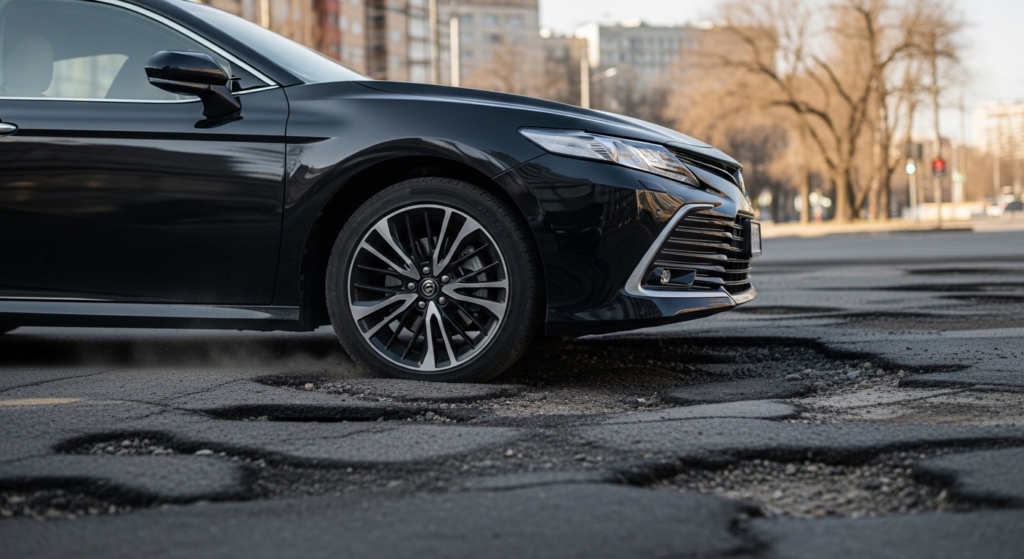
Budgeting for repairs is stressful. Below is an estimated breakdown of Toyota Camry suspension repair cost. Keep in mind that prices vary based on your location, whether you use OEM (Toyota) or aftermarket parts, and if you go to a dealership or an independent mechanic.
Pro Tip: You can check fair price ranges on sites like RepairPal to ensure you aren’t being overcharged.
| Repair Type | Estimated Parts Cost | Estimated Labor Cost | Total Estimated Cost |
|---|---|---|---|
| Front Strut Replacement (Pair) | $250 – $500 | $300 – $500 | $550 – $1,000 |
| Rear Shock/Strut Replacement (Pair) | $200 – $400 | $250 – $450 | $450 – $850 |
| Sway Bar Link Replacement (Each) | $30 – $60 | $70 – $100 | $100 – $160 |
| Control Arm Assembly (Each) | $100 – $250 | $150 – $250 | $250 – $500 |
| Wheel Alignment | N/A | $100 – $150 | $100 – $150 |
For more insights on keeping your vehicle running affordably, check out our guide on Toyota Camry Maintenance Cost.
Can You Drive With Suspension Problems?
Technically, yes, the car will move. However, driving with Toyota Camry struts problems or broken components is highly discouraged. Here is why:
When your suspension is compromised, your braking distance increases. In a panic stop, a car with bad struts will dive forward, taking weight off the rear tires and causing the car to skid or take longer to stop. Additionally, electronic safety systems like ABS and Stability Control rely on the suspension keeping the tires firmly on the road. If the tires are bouncing, these systems cannot work effectively.
If you hear loud clunking or feel the steering wheel shaking violently, pull over. A separated ball joint or tie rod can cause the wheel to fold under the car, causing a major accident.
How to Extend Toyota Camry Suspension Life
You cannot stop wear and tear completely, but you can definitely slow it down. Here is how to keep your Camry riding smoothly for longer:
Adjust Your Driving Habits
This is the biggest factor. Slow down significantly for speed bumps and potholes. Hitting a pothole at 40 MPH puts massive stress on the struts and control arms. Avoid aggressive cornering, which puts unnecessary load on the sway bar links and bushings.
Prioritize Alignment
Get a wheel alignment once a year or every time you get new tires. Proper alignment reduces the strain on suspension components. If you hit a large curb, check the alignment immediately.
Inspect Regularly
During every oil change, ask your mechanic to visually inspect the struts for leaks and the bushings for cracks. Catching a worn bushing early can save your tires from being ruined.
Suspension Problems After 100,000 Miles
It is widely accepted that the original suspension on a daily-driven car performs best before the six-figure mileage mark. Once you cross 100,000 miles, the rubber components have endured a decade of heat cycles and road salt.
If you plan to keep your Camry well past 150,000 or 200,000 miles, prepare for a suspension refresh. Replacing the struts and shocks at this stage will restore the factory ride quality and make the car feel brand new again. For more on what to expect as your car ages, read our article on Toyota Camry Reliability After 100k Miles.
Frequently Asked Questions (FAQ)
Is suspension expensive to fix on a Camry?
Compared to luxury brands or European cars, the Camry is very affordable to fix. Parts are widely available and relatively cheap. While a full suspension overhaul can cost over $1,000, minor fixes like sway bar links are inexpensive.
How long do Camry struts last?
On average, Toyota Camry struts last between 80,000 and 100,000 miles. However, if you frequently drive on rough roads or in cities with many potholes, they may fail as early as 50,000 miles.
Does bad suspension affect safety?
Yes. Bad suspension increases stopping distances, increases the risk of skidding (hydroplaning) in wet weather, and makes the vehicle harder to control during emergency maneuvers.
Which Camry years have the best suspension?
The XV50 generation (2012–2017) and the current XV70 generation (2018–Present) are known for having very durable suspension setups. The 2018+ models specifically offer a much more sophisticated rear double-wishbone suspension that provides better handling without sacrificing durability.
Final Thoughts
Dealing with Toyota Camry suspension problems is an inevitable part of ownership, but it doesn’t have to be a nightmare. The Camry remains one of the most reliable vehicles on the road, and its suspension issues are predictable and manageable.
Listen to your car. That Camry suspension noise or rough ride is a plea for maintenance. By addressing worn struts, broken bushings, or alignment issues early, you protect your investment, ensure your safety, and keep that legendary Toyota ride quality intact for miles to come.
For a broader look at other potential issues with this vehicle, be sure to read our comprehensive guide on Toyota Camry Common Problems.