
Driving a car with a Direct-Shift Gearbox (DSG) is a fantastic experience. You get lightning-fast gear changes, excellent fuel economy, and a sporty feel that traditional automatic transmissions simply cannot match. But owning a Volkswagen, Audi, or Skoda with a DSG comes with a specific, non-negotiable maintenance requirement: the transmission fluid service.
If you are reading this, you probably saw a “Service Due” light on your dashboard, or you just hit a major mileage milestone. Now, you are likely feeling a bit of financial anxiety. You want to know exactly what the dsg oil change cost will be before you hand over your keys to a mechanic.
For a complete maintenance overview, check our VW Golf Maintenance & Service Guide
You may also need to reset service light VW Golf
We wrote this guide to give you honest, straightforward answers. We will break down exactly what you should pay, compare dealership prices to local independent shops, and explain exactly why this specific service costs more than a standard oil change.
What is the Average DSG Oil Change Cost?
Let us answer your biggest question right away. On average, you should expect to pay between $250 and $500 for a professional DSG oil change.
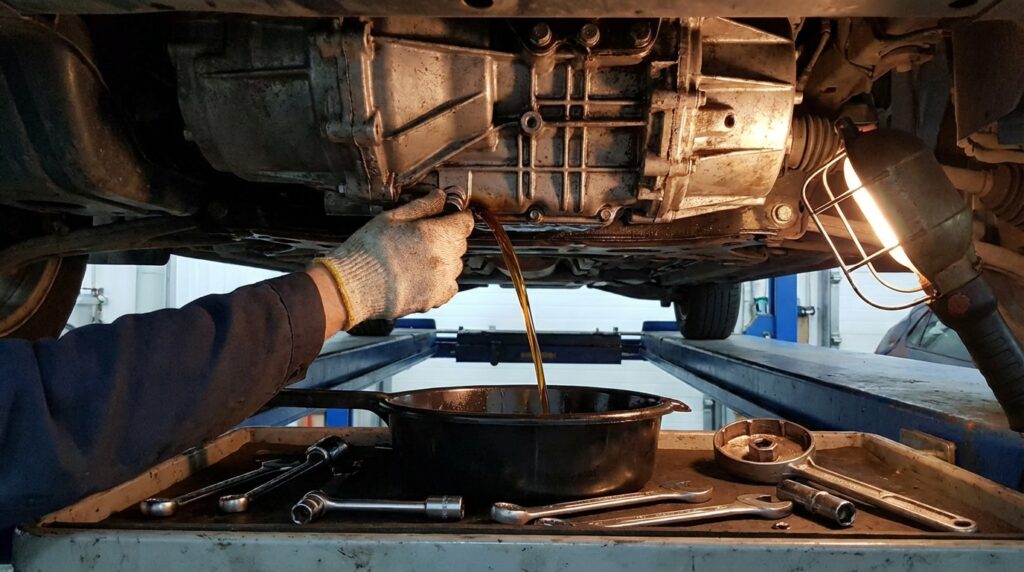
The exact price you pay depends heavily on where you live and who performs the work. A simple fluid and filter change requires specific parts and specialized labor. Unlike a standard engine oil change, a technician cannot simply drain the fluid, pour new fluid into a hole at the top, and call it a day. The process takes time and precision.
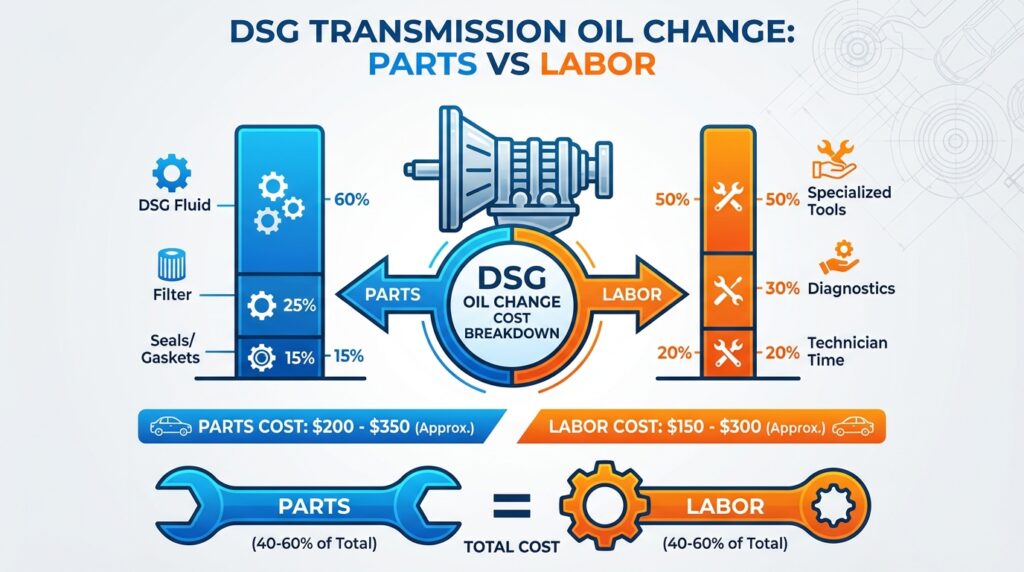
If you take your car to a shop, here is roughly how your final bill breaks down:
- Parts and Fluid: $120 to $180
- Labor Charges: $130 to $320
- Total Estimated Cost: $250 to $500
To help you understand where your money goes, we have created a detailed breakdown table. This shows the average cost of the materials and the labor required to complete the job.
| Expense Category | Estimated Cost Range | What This Includes |
|---|---|---|
| DSG Fluid (5-6 Liters) | $90 – $130 | High-performance, specialized synthetic transmission oil. |
| DSG Filter & O-Ring | $20 – $40 | The paper filter cartridge and the rubber sealing ring. |
| Drain Plug Washer | $2 – $5 | A crush washer that prevents leaks from the drain pan. |
| Professional Labor | $130 – $320 | 1.5 to 2 hours of shop time, including computer diagnostics. |
| Total Cost | $242 – $495 | Varies based on location and shop type. |
As you can see, the parts alone cost over $100. This is because DSG fluid is highly specialized. But the biggest variable in your final bill is the labor rate. This brings us to the most important choice you will make: where to take your car.
Dealership vs. Independent Mechanic: Price Comparison
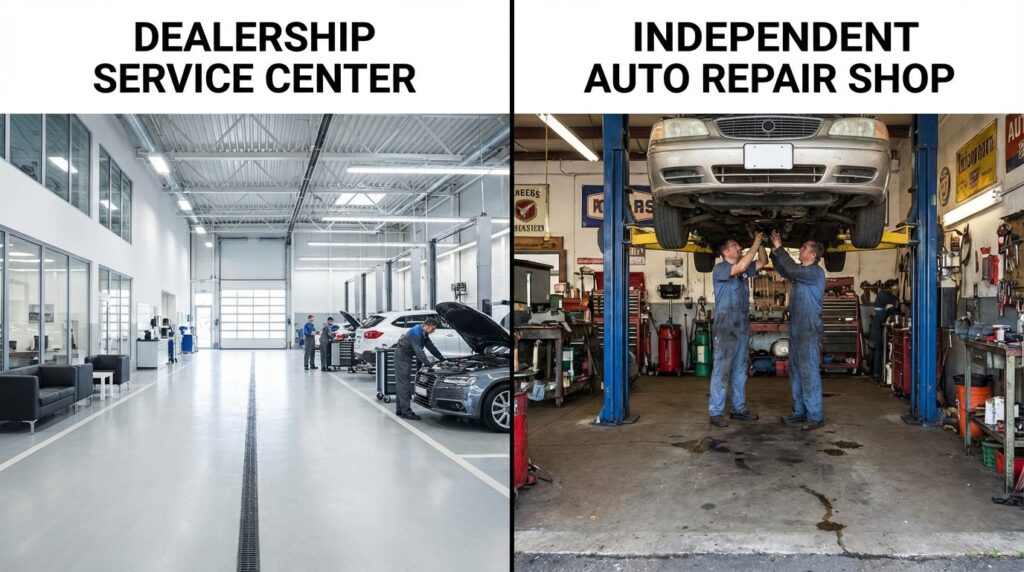
When your car needs service, you generally have two professional options. You can visit the official dealership (like your local VW or Audi service center), or you can visit an independent mechanic who specializes in European cars.
The price difference between these two options is significant. Dealerships have massive overhead costs. They have large showrooms, free coffee bars, loaner cars, and highly trained factory technicians. They pass these overhead costs onto you through higher hourly labor rates.
Independent shops, on the other hand, have lower overhead. They also have the freedom to use high-quality aftermarket fluids (like Liqui Moly or Pentosin) instead of heavily marked-up genuine factory fluids. These fluids meet all the exact same specifications as the factory fluid but cost much less.
The Dealership Experience
If you go to a dealership, expect your DSG oil change cost to sit at the highest end of the spectrum. Most dealerships charge between $350 and $550 for this service. In major cities with high living costs, do not be surprised if a dealer quotes you close to $600.
The benefit of a dealership is peace of mind. You know they use genuine original equipment manufacturer (OEM) parts. You also know they have the exact software needed to reset your service codes.
The Independent Shop Experience
If you choose a reputable, independent European auto repair shop, you will usually pay between $250 and $350. This is the sweet spot for most drivers.
A good independent mechanic will still use OEM-quality fluid and filters. They also own the diagnostic tools required to measure the transmission temperature correctly. You get the exact same quality of service for a fraction of the price.
Similar tools are used when performing a VW Golf battery replacement
| Service Provider | Average Cost | Pros | Cons |
|---|---|---|---|
| Official Dealership | $350 – $550+ | Genuine parts, factory-trained techs, loaner cars available. | Most expensive option, potential upselling on other services. |
| Independent Euro Shop | $250 – $350 | Much more affordable, personalized service, OEM-quality parts. | No loaner cars, must ensure they have the right computer tools. |
| General Lube Shop | Not Recommended | Cheap and fast. | High risk of using wrong fluid or skipping the temperature check. |
“Never take a DSG transmission to a cheap, quick-lube oil change shop. They rarely stock the correct fluid, and they almost never have the computer software needed to check the fluid temperature. A botched DSG service can destroy a $4,000 transmission.” — European Auto Specialist
Why is a DSG Service So Expensive?
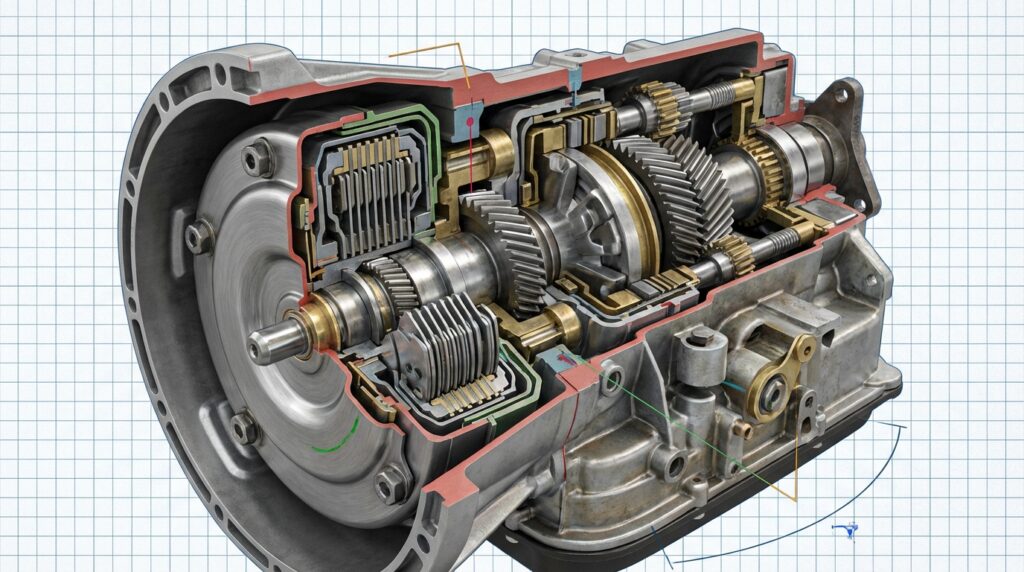
If you previously owned a car with a standard automatic transmission, you might remember paying around $150 for a transmission flush. So, why does a DSG cost double or triple that amount?
The answer lies in how the transmission is built and the complex procedure required to service it. Here is a clear breakdown of why you pay a premium for this maintenance.
1. The Cost of Specialized Fluid
A DSG is a “wet clutch” transmission. This means the internal clutches literally bathe in transmission fluid to stay cool and lubricated. Because the clutches create a massive amount of friction and heat, the fluid must endure extreme conditions.
Standard Automatic Transmission Fluid (ATF) will destroy a DSG. You must use a highly specific synthetic fluid designed to handle shear forces, prevent foaming, and provide the exact right amount of friction for the clutches to grab. This advanced chemical engineering makes the fluid expensive—often $20 or more per liter. And your car needs about five to six liters.
2. The Bottom-Fill Procedure
On an older car, a mechanic drains the old fluid out of the bottom and pours the new fluid into a dipstick tube at the top. A DSG does not have a dipstick. It does not even have a standard fill hole at the top of the engine bay.
To fill a DSG, the mechanic must pump the fluid upwards through the drain hole at the bottom of the transmission using a specialized pressurized tool (often called a VAS6262 tool). Pumping fluid upward against gravity is a slow, messy, and precise process.
3. Proprietary Tools and Software
This is the biggest reason labor costs are high. You cannot simply pump five liters of fluid in and drive away. Fluid expands when it gets hot.
To ensure the transmission holds the exact perfect amount of fluid, the mechanic must connect a computer to the car’s diagnostic port. They start the engine and monitor the internal transmission fluid temperature. They must wait until the fluid reaches precisely 35°C to 45°C (95°F to 113°F). Only at this exact temperature can they pull the plug and let the excess fluid drain out.
This temperature-dependent leveling process takes time. If the mechanic rushes and checks it when it is too cold, the transmission will be overfilled. If they check it when it is too hot, it will be underfilled. Both scenarios cause poor shifting and damage.
How Often Should You Change DSG Fluid? (The 40k Rule)
Now that you know the cost, you need to know the schedule. The automotive industry calls this the “40k Rule.”
You must change your DSG fluid and filter every 40,000 miles (or roughly every 4 years, whichever comes first).
Some newer 7-speed DSG models claim they can go 80,000 miles between services. However, most experienced European auto mechanics strongly disagree with this extended interval. Mechanics who open up these transmissions every day still recommend a 40,000-mile interval to keep the internal parts safe.
If you decide to save money by skipping the 40,000-mile service, you are gambling with a very expensive part. Inside the transmission is a computer called the “Mechatronic Unit.” It controls the shifting. Dirty, old fluid is full of microscopic metal shavings from the clutches. This dirty fluid will eventually clog the tiny solenoids inside the Mechatronic Unit. Replacing a burned-out Mechatronic Unit costs upwards of $2,000. Changing your fluid is cheap insurance.
For more general information on how regular fluid changes save your vehicle, you can read the Kelley Blue Book guide on transmission maintenance, which echoes the importance of never ignoring your gearbox.
Symptoms You Need a DSG Fluid Change Immediately
Sometimes, we buy used cars without a complete service history. If you do not know when the last owner changed the fluid, you need to pay close attention to how the car drives. The transmission will usually tell you when it is struggling.
If you experience any of the following symptoms, schedule a service appointment immediately:
- Jerky or Clunky Shifts: The car lurches forward aggressively when shifting from 1st to 2nd gear, or downshifting as you come to a stop.
- Hesitation from a Stop: You press the gas pedal, but the car pauses for a second or two before moving forward.
- Slipping Gears: The engine RPMs go up, but the car does not accelerate properly, meaning the wet clutches are slipping.
- Shuddering in Reverse: The car shakes or vibrates heavily when you back up.
- Flashing “PRNDS” Lights: If the gear indicator lights on your dashboard start flashing, the computer has detected a major transmission fault. Stop driving and get the car scanned immediately.
Can I Change DSG Fluid Myself? (DIY Costs & Required Tools)
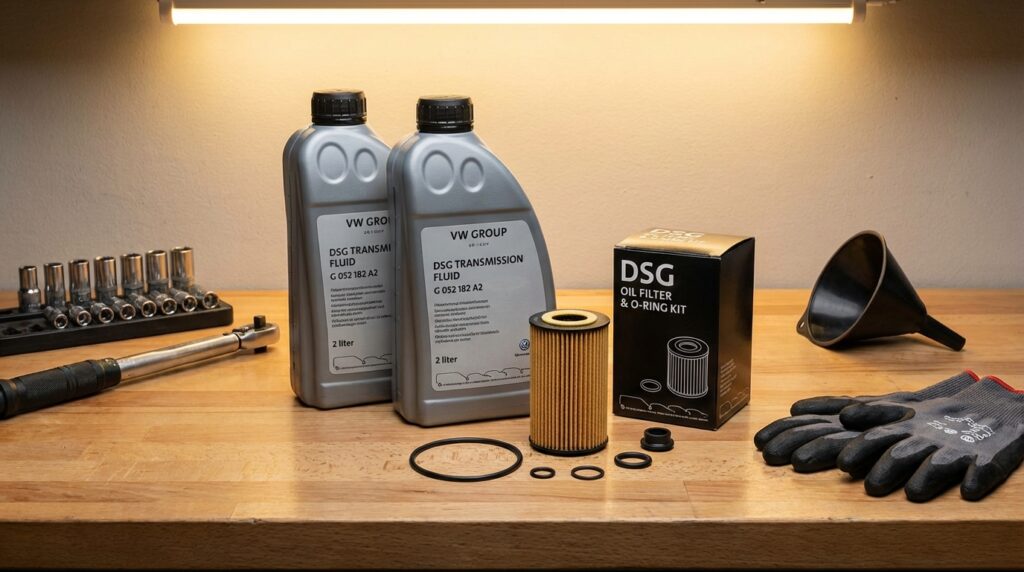
If you love working on cars and want to eliminate the high labor rates, you can absolutely perform a DSG fluid change at home. By doing it yourself, your total dsg oil change cost drops down to just the price of the parts.
DIY Cost Breakdown
You can buy a complete DIY DSG service kit online from reputable European car part suppliers. These kits include the fluid, the filter, the O-ring, and the crush washer.
Total DIY Cost: $120 to $150.
Regular maintenance like checking your VW Golf coolant type helps avoid expensive repairs
Tools You Will Need
Before you get excited about saving $200, realize that you need some special tools. If you do not already own these, your initial cost will be higher for your first DIY service.
- Car Lifts or Jack Stands: The car must be completely level in the air. You cannot use just ramps on the front wheels; the fluid will not drain or fill evenly.
- Fluid Filling Tool: You need a bottom-fill pump or a specialized funnel tube that threads into the drain hole.
- Metric Socket Set & Hex Bits: You need specific bits (usually a 14mm hex and an 8mm hex) to remove the drain plugs and the battery tray to access the filter.
- Diagnostic Tool: You need a computer scanner (like VCDS or OBDeleven) to read the live fluid temperature on your smartphone or laptop.
The “Top-Fill” Alternative Method
Some home mechanics avoid the messy bottom-fill tool by using the “top-fill” method. They drain the fluid from the bottom, measure exactly how much came out, and pour that exact same amount back into the tiny filter housing hole on top of the transmission.
While this method saves money on special tools, it is incredibly slow. The fluid takes a long time to drain down through the filter hole. Furthermore, if the transmission was underfilled before you started, you will be putting an underfilled amount back in. The factory bottom-fill method with temperature checking is always the safest route.
Frequently Asked Questions (FAQs)
Is DSG fluid the same as regular automatic transmission fluid?
No. Standard automatic transmissions use torque converters. A DSG uses dual wet clutches. DSG fluid is heavily formulated with specific friction modifiers to stop the clutches from slipping while keeping them cool. Using standard ATF will ruin your transmission.
Do dealers really use “Lifetime” fluid?
Some car manufacturers claim their transmission fluid is a “lifetime” fluid. However, most mechanics define the “lifetime” of a vehicle as 100,000 miles. Fluids break down over time due to heat and friction. If you want your car to last past 100,000 miles, you must change the fluid.
How long does a DSG oil change take at a shop?
A professional shop will usually complete the service in about 1.5 to 2 hours. A large portion of this time is simply waiting for the fluid to reach the perfect 40°C temperature for final leveling.
Can I just add fluid if it is low?
DSG transmissions are sealed systems. They do not consume fluid. If your fluid is low, it means you have a leak somewhere that needs to be repaired. You cannot easily top it up without going through the temperature-checking procedure.
Final Thoughts on Managing Your Costs
Nobody enjoys paying hundreds of dollars for routine maintenance. However, understanding the exact dsg oil change cost helps you budget properly and avoid dealership sticker shock.
Expect to pay around $300 at a trustworthy independent shop, and remember that this cost only happens once every 40,000 miles. Think of it as a small tax you pay every few years to enjoy one of the fastest, most responsive transmissions on the road today.
Whether you choose to pay a professional or get your hands dirty in your own garage, never skip this service. Fresh fluid keeps your clutches shifting smoothly and protects your wallet from massive repair bills down the road.